
Reimagining Aging in America
- Aug 5, 2025
- 3 min read
By: Taylor Turner, MPH
Last month, I attended the Alliance for Health Policy’s Signature Series
Summit on Aging in America—an event that could not have been more timely. As the U.S. faces a dramatic demographic shift, with the population of adults aged 65 and older expected to grow by nearly 50% by 2050, the policy landscape is at a turning point. The event offered a valuable forum to explore emerging policy priorities, hear diverse perspectives, and reflect on how we, as a society, can better support older Americans today and in the decades ahead.

As the aging population expands, so does the need for coordinated, forward-thinking policies that can meet the evolving needs of older adults. Aging is not a siloed issue, it intersects with many other issues including disability, caregiving, and long-term care. The longer we live, the more likely we are to experience disability, rely on support systems, and engage with complex care networks. This reality presents an opportunity for policymakers and stakeholders to build systems that are interconnected, efficient, and rooted in dignity.
This gathering came on the heels of two significant developments in federal aging policy: the restructuring of the Administration for Community Living (ACL) and the reauthorization of the Older Americans Act. Earlier this year, the U.S. Department of Health and Human Services (HHS) announced plans to dissolve the functions of the ACL into the newly created Administration for Children, Families, and Communities, the Office of the Assistant Secretary for Planning and Evaluation (ASPE), and the Centers for Medicare & Medicaid Services (CMS).
The OAA has been reauthorized several times to reflect the evolving landscape of aging in America. Most recently reauthorized in 2020, the bill was slated to be reauthorized in 2024, but was not included in the end of year Continuing Resolution (CR) in December 2024; therefore, it is again under consideration by the 119th Congress. On June 18, 2025, Senator Bill Cassidy (R-LA) introduced S.2120 – Older Americans Act Reauthorization Act of 2025, with strong bipartisan backing, which proposes reauthorizing the OAA through fiscal year 2030 and includes key provisions to strengthen health outcomes, expand support for caregivers, improve services for Native elders, and bolster the long-term care ombudsman program
Reflections from the Alliance for Health Policy’s Aging in America Summit
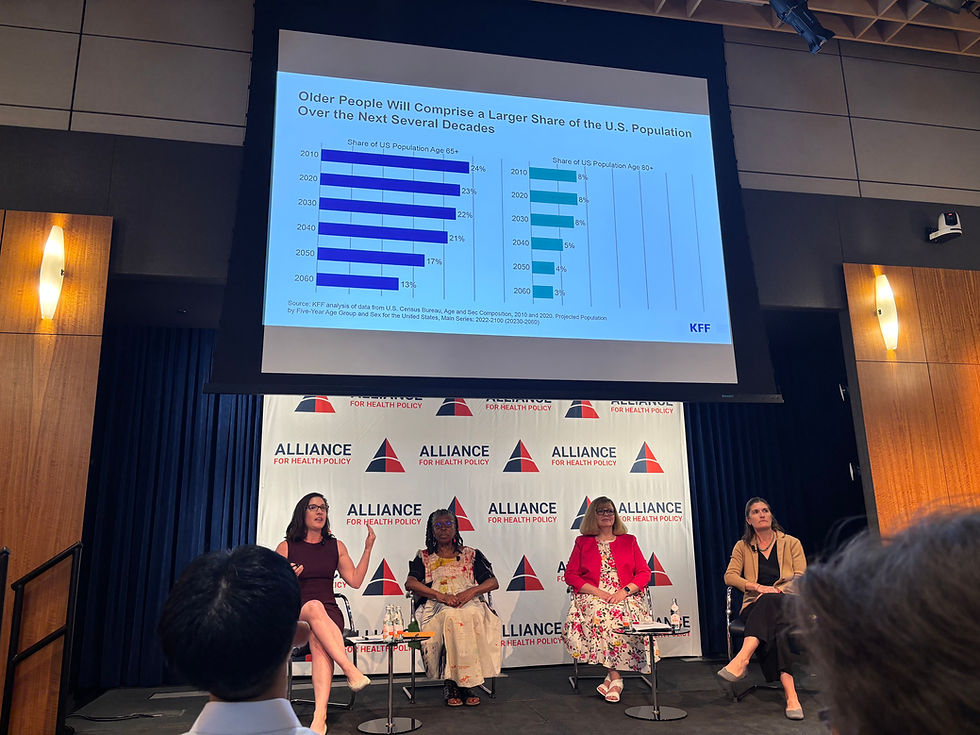
The Aging in America Summit underscored the urgent need to align policy innovation with real-world service delivery. While advances in technology and care models are helping older adults live more independently, policy and funding structures, particularly the disconnect between Medicare and Medicaid, often lag behind. Improving coordination between these systems could significantly reduce care gaps, improve outcomes, and lower costs for the growing number of dually eligible older adults.
A clear takeaway from the summit was the widespread desire among older adults to age in place, remaining in their homes and communities rather than transitioning into institutional settings. Yet, this vision requires far more than just intent. It demands investment in housing, transportation, home and community-based services (HCBS), technology, and a well-supported care workforce. Ensuring aging in place is an option for everyone, not just those with personal resources, will require meaningful federal and state policy shifts and stronger cross-sector collaboration.
Long-term care was another focal point. As demand grows, states like Washington are exploring new models, such as the Long-Term Care Trust Act, which uses a payroll tax to fund future care services. Programs like this show how states can proactively address long-term care affordability and planning, challenges that will only intensify as our population ages.
The summit also highlighted the essential role of caregivers, both paid and unpaid. Many family caregivers juggle work, financial pressures, and their own health needs, often with limited support. Expanding training, financial assistance, and mental health resources for caregivers is not just supportive, it is foundational to an aging system that works. With more older adults also stepping into caregiving roles themselves, policies must reflect the full spectrum of caregiving experiences.
Ultimately, the summit reinforced that aging intersects with nearly every sector of society. It is not just a policy issue, it is a shared opportunity to create systems that promote dignity, autonomy, and equity in aging. The conversations sparked at this event laid a strong foundation, and I am hopeful about the momentum they will build.


